The Transformation of Creativity
By now, we can all see how Artificial Intelligence (AI) is rapidly transforming many aspects of our lives, from how we work to how we interact with technology and others in our daily routines. From automating mundane tasks to offering advanced data analysis, AI is enabling individuals and organizations to focus on more strategic and creative endeavors.
This groundbreaking technology has the potential to revolutionize a wide variety of industries, making processes more efficient and improving overall productivity. Industries such as healthcare, finance, and manufacturing stand to gain significantly from AI-driven solutions that improve decision-making and enhance customer experiences.
However, amid these advancements, there are growing concerns that AI may negatively impact human creativity and originality in the future as it increasingly takes over tasks that require innovative thinking and artistic expression. Ultimately, finding a balance between leveraging AI’s capabilities while nurturing human creativity will be crucial in shaping a future where both can coexist harmoniously.
One of the main ways AI can kill human creativity is by automating creative tasks. This automation can lead to a reduction in the human touch that gives creative work its unique character and emotional depth.
For example, AI algorithms can already create music and art that is indistinguishable from human creations. These advancements also spark debate over originality, as the line between human and AI-generated art blurs.
While this may be impressive from a technological standpoint, it raises questions about the value of human creativity in a world where machines can replicate it perfectly. Ultimately, this challenges us to redefine what creativity means in an age dominated by artificial intelligence.
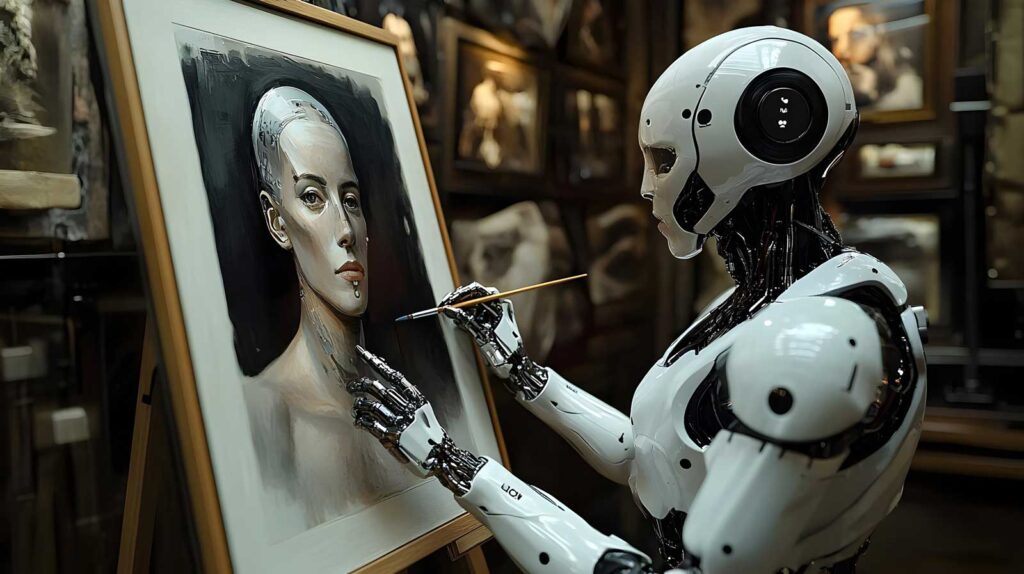
When I see AI images, I wonder why anyone would use them beyond illustrative purposes, which I view differently from actual art. But in reality, I know that their use comes from the simple ease and immediate gratification. It is, after all, easier to find an image and download it than it is to create something from scratch. Even as a designer, I am guilty of this as well. The image above of a robot at the easel is a stock AI-generated image, but I would never call it “art.” The most creative thing I had to do was search Adobe Stock for relevant images.
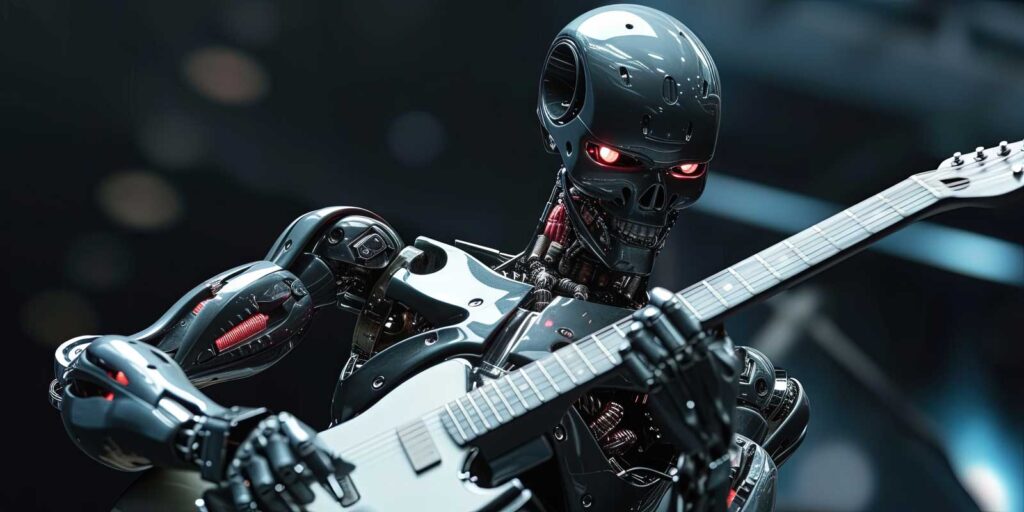
Sadly, not only has the visual arts been significantly affected, but the realm of music creativity is also taking a substantial hit as a direct result of advancements in AI technology. Notable examples of AI-generated music that have gained traction include popular tracks such as “Walk My Walk” by Breaking Rust, which impressively reached #1 on a Billboard chart, captivating listeners worldwide. Additionally, emerging AI artists like Velvet Sundown are making their mark on platforms such as YouTube and Spotify, underscoring the growing influence and presence of artificial intelligence in the music industry.
There is something special about live music expressed through passionate talent, years of practice, and emotion. Imagine a group of teenagers in the future forming a band and saying, “We were super influenced by the AI rock movement of the late 20s.” Personally, I hope this never happens, but seeing where things are going, it’s more likely than not.
The 30% Rule
The AI 30% rule is a widely accepted guideline that suggests AI should handle approximately 70% of routine and repetitive tasks. In comparison, humans focus on the remaining 30% that require critical thinking, creativity, and decision-making. This approach advocates viewing AI not merely as a replacement for human workers, but rather as a versatile tool that augments human capabilities and enhances productivity. By automating the more predictable and mundane parts of a job, AI allows humans to allocate their time and energy towards higher-value tasks that leverage uniquely human skills, such as emotional intelligence, complex problem-solving, and innovative thinking. Ultimately, this partnership between AI and humans aims to create a more efficient and fulfilling work environment for everyone involved, ensuring that both technology and human contributions are valued and optimized.
Personally, I believe that we as creators should flip those numbers if we’re going to use AI at all, and use it sparingly, like seasoning. And when it comes to creativity, I feel that art, writing, and songwriting should be created by hand, from the heart, and that AI-generated anything creative is soulless at best.
In Full Disclosure
I have a confession: I, too, use AI for certain tasks. There, I said it. But I don’t use it to create Art. My use of Artificial Intelligence is mostly limited to editorial, such as the images in this post and throughout this website, and when I use them, I share that they are AI-generated.
Since AI was integrated a couple of years ago into Photoshop, I’ve enjoyed using it to edit images, mostly in my car show posts, to remove distractions and unwanted content (again, mostly for editorial purposes).
I also use Grammarly, an AI-powered writing assistant, to help me with grammar, spelling, punctuation, tone, clarity, and style.
Beyond that, I’ve resisted using AI much, mostly because I truly enjoy the creative process and believe AI limits it.
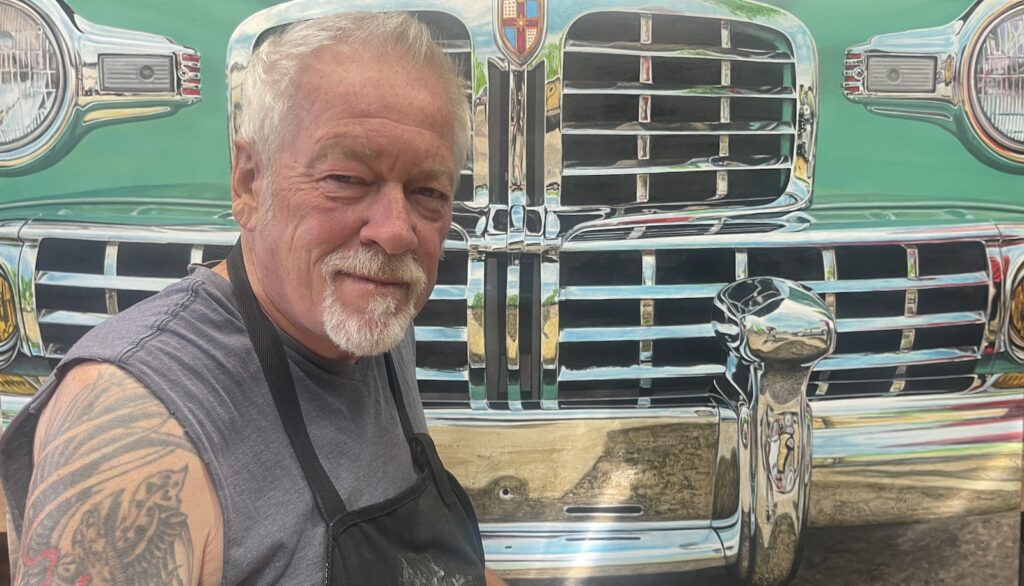
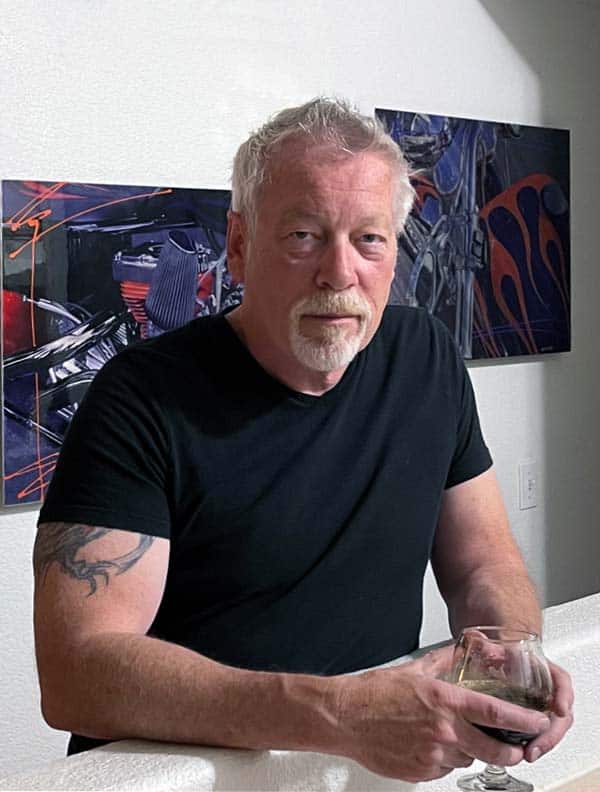
Artist A.D. Cook self-portrait with CONTINENTAL painting on panel, 36″ x 60″ © A.D. Cook 2025
Robot at easel, and Robot playing guitar images © 2025 Adobe Stock. Licensed for editorial.
- About the Author
- Latest Posts
- More info

A.D. is an artist who started drawing at a young age. Throughout his life, he has worked with different creative tools in traditional and digital art and design. His art and writings have been showcased in various publications such as Airbrush Action Magazine, Airbrush Magazine, American Art Collector, Art & Beyond, Dream To Launch, Easyriders, Las Vegas City Life, Las Vegas Weekly, L’Vegue, ModelsMania, Quick Throttle, and The Ultimate Airbrush Handbook.