
The First Creative Coalition General Assembly

CCAI Webinar Review • 041326

April 13, 2026 — I was excited to join the Creative Coalition on Artificial Intelligence for their first General Assembly (via Zoom), hosted by CCAI co-founder Daniel Kwan and CCAI interim Executive Director Ted Tremper, and project managers Orit Michiel and Jim Geduldick (along with special guests).

Kicking off at 6:00, the host shared a recap of what CCAI has been building, their 2026 roadmap, and the reveal of their first two major projects.

Later, the hosts created Breakout rooms around this session’s theme — “What is the single most important thing CCAI can achieve in 2026?” It sounded interesting, but I was pressed for time. I am curious to see the results sometime.

Open AMA with CCAI’s interim Executive Director Ted Tremper until every question is answered and every comment heard.

SPECIAL GUEST – Liz Barry, Executive Director, Metagov, a laboratory for digital governance in a digital age.

Technology should strengthen human creativity, not undermine it.

It Is Time For US To Have Radical Imagination

A few points of focus at the first CCAI General Assembly included an in-depth discussion of a significant and current problem they call the “Tower of Babel.” The prevailing point raised during this discussion is that the industry is profoundly fractured — everyone uses different languages, definitions, and frameworks to understand and implement AI. Essentially, we find ourselves in a situation where we are not speaking the same language. This discrepancy creates a critical barrier to collaboration and understanding within the field. No shared language = no shared power; without a common linguistic framework, forging alliances and driving meaningful advancements in artificial intelligence becomes increasingly challenging.

What happens without shared definitions? First off, we experience definitional fragmentation and operational ambiguity. That leads us all to speak a different language, of sorts, when discussing AI. I say one thing, you hear another, which leads to confusion and redundant effort. In the end, the people with the most resources define the terms, and everyone else reacts.
Divided, We Get Defined. United, We Define.

IF WE STAY FRAGMENTED

  • Big Tech platforms negotiate with each party separately — playing one organization against another.
  • Outside forces set the terms. AI companies, regulators, and platforms define what “AI-generated” means — and our industry inherits their vocabulary.
  • The creative workforce — and the companies that employ them — lose leverage together.

IF WE SPEAK WITH ONE VOICE

  • The entertainment industry defines AI on its own terms. Our definitions become the reference point — for platforms, regulators, and the global creative economy.
  •  Every entity — guild, studio, producer, or independent creator — enters future negotiations with a shared vocabulary that’s already been ratified industry-wide.
  • We establish a model for human-led AI governance that other industries will follow.

Source: Transcribed from CCAI General Assembly notes.

ONE PLAN: ONE VOCABULARY​

CCAI is not negotiating how AI technology is used. They are creating a unified set of definitions and cataloging existing standards so every future conversation starts from common ground.

They are accomplishing this by establishing definitions through a common language and creating a reference framework.

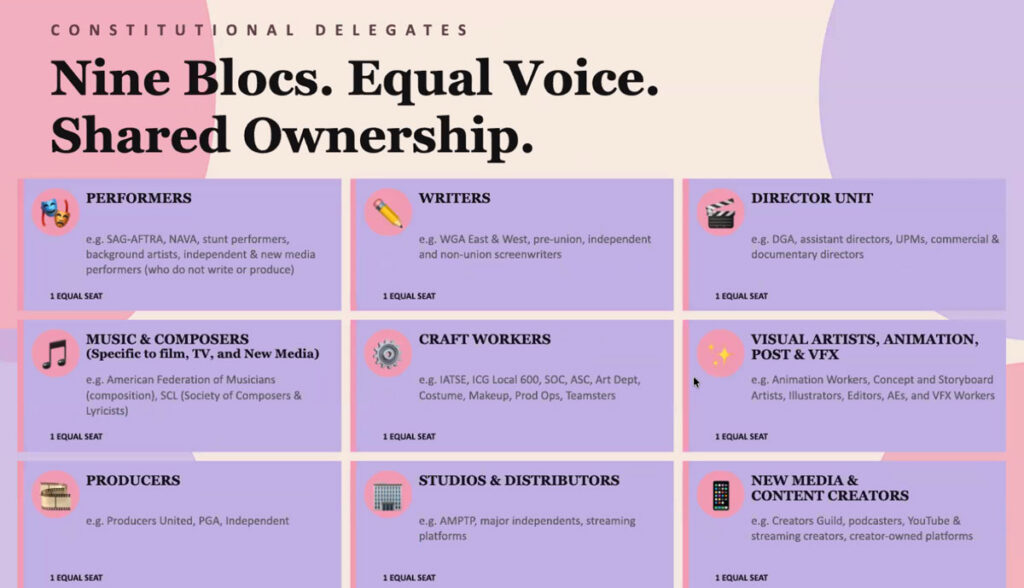
CCAI has defined Constitutional Delegates consisting of nine blocs with equal voice and shared ownership.

WORKING TOGETHER

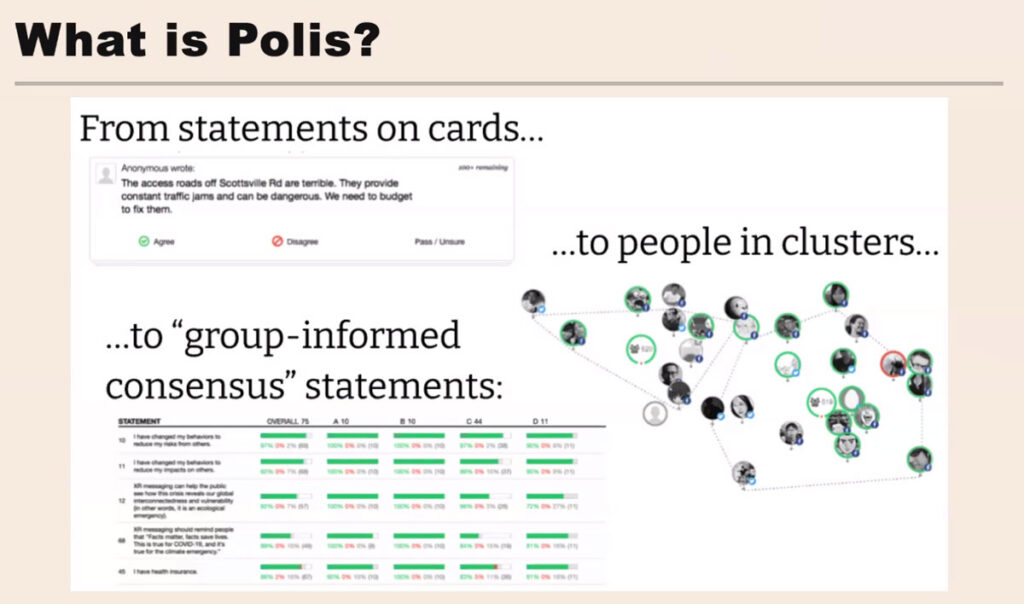
CCAI aims to effectively use Deliberative Democracy Tools to Build Consensus at Scale, including the innovative platform POLIS, to gather extensive, diverse stakeholder input, identify shared priorities across groups, and inform decision-making in an inclusive, evidence-based, and legitimate manner. By leveraging these tools, CCAI seeks to enhance democratic engagement and foster collaboration among participants, ensuring that a wide range of voices are heard and considered in the decision-making framework.

Group Informed Consensus

The ultimate goal is to foster collective intelligence and a deeper democracyPOLIS does the opposite of what social media algorithms do. It prioritizes connection over conflict, promoting dialogue rather than division. Rather than looking for what outrages people, it’s looking for where we find agreement.

Instead of amplifying the loudest voice or producing a winner and a loser, it finds the thing that genuinely different groups of people can all say yes to — and nothing counts as a consensus unless every group agrees.

This is the opposite of a 51 to 49% vote. Instead, we’re striving for a collaborative understanding of various perspectives. We’re not voting on binaries. Through this process, we can create a more inclusive platform for everyone’s voice. Instead, we all get to vote on everything, and then discover where we align and where we ned to deliberate.

Click here to learn more about POLIS.

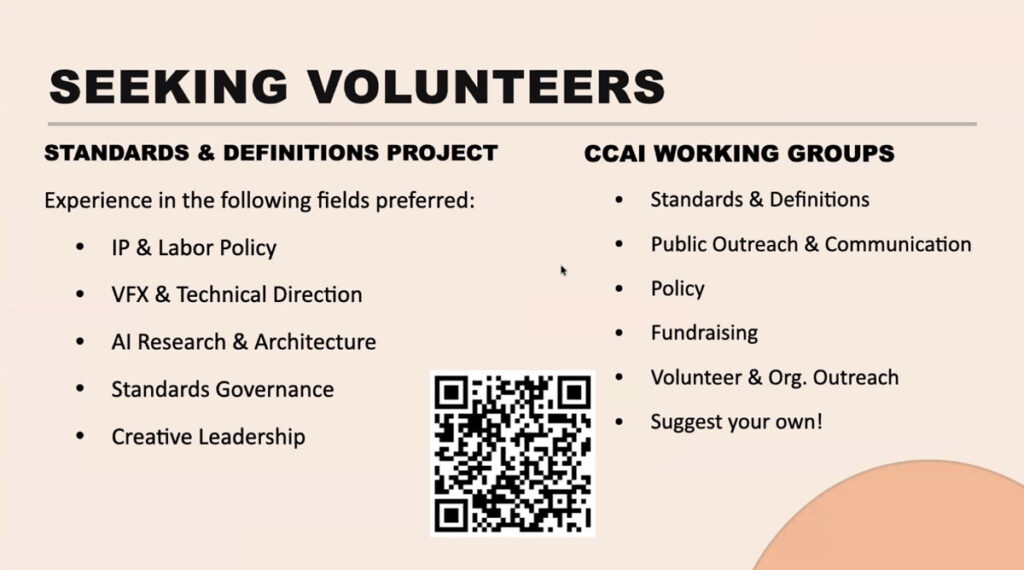
SEEKING VOLUNTEERS

CCAI is seeing volunteers to help with their Standards & Definitions Project and CCAI Working Groups.

NOTES

CCAI Goals

The Creators Coalition on AI (CCAI) will serve as a central coordinating hub to upgrade our industry’s systems and institutions by convening an industry-wide AI Advisory Committee to establish shared standards, definitions, and best practices, as well as ethical and artistic protections for if and when AI is used. Using our collective leverage and expertise, we will be guided by four core pillars:

  1. Transparency, Consent, and Compensation for Content and Data: AI companies build their products out of vast troves of human works and personal data, often without getting permission or offering compensation. All people have a right to be compensated for the value they generate in the digital world. To operationalize this, we propose four criteria training models must meet: Consent, Controls, Compensation, and Transparency & Enforcement

  2. Job Protection and Transition Plans: We recognize that, as with every technological revolution, job loss is inevitable. That said, the speed and scale of AI-driven disruption are unprecedented and risk accelerating global wealth inequality to levels unseen in modern history. Many workers in the traditional media industry have no ownership of the content they helped create, and they never could have anticipated their work being used in ways that would render their jobs obsolete. As an industry built on human creativity, we have a duty to protect vulnerable workers and create the conditions that ensure creative labor remains valued, viable, and attractive to future talent. Though we cannot singlehandedly solve the societal challenges of automation, we can be a model for responsible transition and visionaries for what the future of work can look like.

  3. Guardrails against Misuse and Deepfakes: AI-generated content is quickly becoming indistinguishable from reality, threatening not only individual reputations but also society’s shared reality. The very technology used by some as a tool for creativity is being weaponized by others to deceive, defame, and destabilize. We need collaboration with tech builders to help us establish robust systems for accountability and safeguards to distinguish authentic content from AI-generated fabrications before these technologies are adopted into creative pipelines.

  4. Safeguarding Humanity in the Creative Process: We are facing the Industrialization of Creativity. Creativity is not just for self-expression; it is how societies innovate and progress. Storytelling is not just entertainment; it is how we transmit values, empathy, and meaning. What happens when we relinquish humanity’s most ancient and fundamental capacities to machines at scale? As creators and storytellers, we must steward this transition by protecting craft and creativity to guard against the far-reaching damage that automated storytelling and hyperindividualized consumption could inflict on the societal and moral fabric that binds us.

IMAGE CREDITS

CCAI header image and logo © 2026 CCAI. Used for editorial.
Babel image © 2026 Adobe Stock (AI). Licensed for editorial.
Nine Blocs graphic © 2026 CCAI.
All other logo © copyright of their respective owners.

RELATED POSTS

AI vs ART   |   A BETTER AI   |   MORE THAN EVER

SHARE THIS STORY
Facebook
LinkedIn
Threads
Twitter [X]
Email
Print
MORE FROM THIS AUTHOR
Scroll to Top